Yarns with Yachties: How Andrew McFarlane built Rolleston rope-maker Nautilus Braids into a New Zealand favourite

In the first episode of Yarns with Yachties, a new collaborative series from Yachting New Zealand and Live Sail Die, we caught up with Andrew McFarlane at the Nautilus Braids factory in Rolleston, just outside Christchurch. McFarlane is the second generation of his family to run the business, which began with a backyard experiment and an old Davidson 28 before growing into one of New Zealand’s few rope manufacturers — and the only one on the South Island. He talks about the family business, his sailing journey, the craft and science behind rope-making, his Elliott 5.9 Retro and what keeps him coming back to the sailing community.
Watch the full first episode here.
Not long after Andrew McFarlane and his crew bought Retro — a boat with serious pedigree, once owned by New Zealand sailing great Mike Sanderson — he heard through the grapevine that Sanderson had kept a book of the boat’s tuning settings.
McFarlane decided to get in touch and sent Sanderson an email. Minutes later, his phone rang.
“Andy, congratulations on buying the boat, great to hear it’s going... yeah, absolutely, more than keen, let’s have a yarn about what we used to do,” Sanderson says.
McFarlane still laughs at the memory: "Mike, if you’re watching this, we need to have that conversation again. I don’t think I retained any of it; I was way too nervous!"
It turns out the tuning book doesn’t exist, but for McFarlane, the experience is a perfect example of what keeps drawing him back to sailing.
“I really love the camaraderie. While we’re out there competing against your peers, everyone is happy to lend a hand, give you their experience, give a suggestion that might get you that extra half a knot of boat speed."
That generosity, he says, applies regardless of who you’re talking to.
And it’s a spirit McFarlane now tries to give back through his Christchurch-based business, Nautilus Braids.
Because while McFarlane spends his working days making the ropes sailors use to make their boats go faster, he’s just as interested in helping the people who use them.
The company supports sailors and sailing events around the country, from established campaigns to young sailors finding their feet, supplying everything from tapered sheets and control lines to complete rope packages.
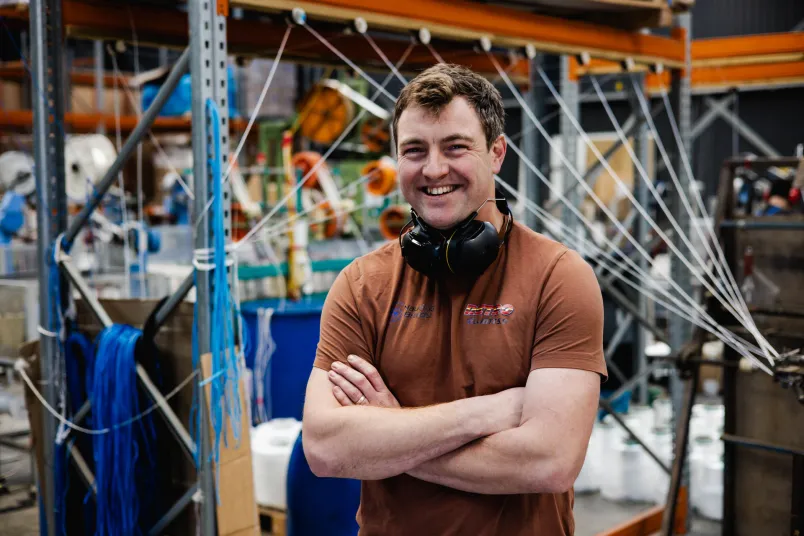
Andrew McFarlane runs Nautilus Braids out of Rolleston, outside Christchurch. Photos / Suellen Hurling, Live Sail Die
Nautilus Braids began when McFarlane was about five years old.
His father, Ian, was working as a scientist in the woollen industry and had access to machines of various configurations used for processing textiles. The family also had an old Davidson 28 — and, inevitably, it needed a new set of sheets.
“He had a bit of a head-scratch and said, ‘I think I could make those myself, let’s give it a go,’” McFarlane says.
What started as a backyard experiment gradually grew into a business.
“It came out of a bit of Kiwi ingenuity and Number 8 wire, backyard mentality."
Today, Nautilus is one of only a couple of rope manufacturers based in New Zealand — and the only one on the South Island.
“Now it’s a pretty cool little success story; we’re very proud of it."
For McFarlane, however, becoming the second generation of the family business wasn’t always part of the plan. Quite the opposite.
“I was forced to roll reels of rope for pocket money as a child and decided that really wasn’t where I wanted to end up,” he says.
Instead, he studied electrical engineering at Canterbury University and moved to Marlborough. It was there that sailing took hold.
McFarlane had grown up cruising the Marlborough Sounds, but had missed out on the traditional dinghy pathway.
“Unfortunately, as a kid I missed out on the dinghy scene, got into a P-Class without knowing what I was up to, and it scared the achiever out of me!"
Keelboat sailing proved a better fit.
After meeting several people in the local yachting scene, McFarlane fell in love with it.
“I hopped around a few boats until I was lucky enough to get involved with the team on Satellite Spy — thank you Mr Kerr and Mr Robertson — and that was really the game-changer,” he says.
“We did an awful lot on Satellite Spy and just haven’t stopped since.”
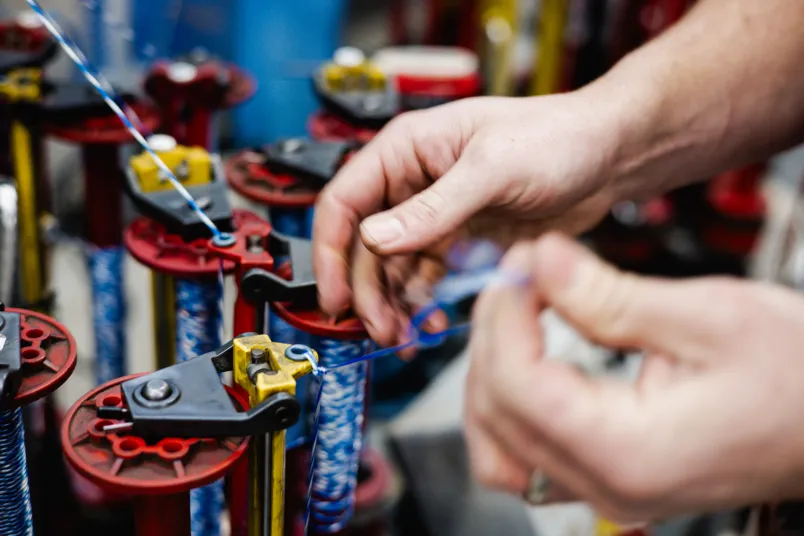
McFarlane studied electrical engineering at Canterbury University before becoming hooked on sailing.Photos / Suellen Hurling, Live Sail Die
After having children, Ian McFarlane eventually approached him with an opportunity. He was considering selling the business and asked Andrew whether he wanted to come home and have a crack.
“It was a natural fit with my interest and passion in yachting and making stuff for yachties,” he says.
There was also one particularly compelling part of the pitch.
“When the pitch was, ‘Andrew, come down and look after the business; we need a yacht for a test development platform, you can choose whichever one’ — my hands were tied; decision made right there!"
It turns out there are worse ways to be recruited.
“I won’t lie, being able to go for a yacht in the 5.9 and calling it product development is a pretty good perk,” McFarlane laughs.
But the job is considerably more hands-on than simply taking a yacht out for a sail.
Nautilus is a small operation, with just seven people on the books, and McFarlane is involved in almost every part of the business.
“I make rope, I do all the strength testing, I do all the splicing, I probably should be doing a bit more marketing, but that’s the nature of the business."
Thankfully, he says, there’s a great team around him. And there’s certainly no shortage of variety.
At the heart of the business is a 24-carrier braiding machine.
“It makes all of our rope, or lots of our rope — typical yacht braids,” McFarlane says.
But Nautilus makes far more than sailing rope.
The company’s customers span recreational yachting and commercial fishing, agriculture, mountaineering, arboriculture, abseiling, equestrian sports, gliding and even theatrical rigging.
“Our customer base is divided into thirds. A third of all the products we make go into recreational yachting and commercial fishing. Another third is into the ag sector, supplying automatic cut-release cords, travelling irrigator winch ropes and things like that. The other third is everything else — mountaineering ropes, arborist ropes, abseil ropes, dog leads, horse leads, tow lines for gliders, special lightweight ropes for theatrical rigging where they’re working in the gantries up above,” he says.
“It’s far and wide what we do.”
The technology behind it might look deceptively simple, but there’s a considerable amount of science in a modern piece of rope - “virtually everything is synthetic".
Polyester is the bread-and-butter fibre for cruising boats and typical applications, alongside nylon and polypropylene.
Then come the high-performance fibres — Dyneema, Vectran, Kevlar and PBO.
“Things like that that are just getting stronger and stronger, truly incredible,” he says.
The machinery itself hasn’t changed dramatically.
“There’s not so much change in the braiding machinery — the process of making rope virtually hasn’t changed over the years — the scientific improvement is from the fibre."
And while the basic process may be straightforward, McFarlane is reluctant to give away too much of what happens inside the factory.
“There’s a bit of process; rope-making’s a pretty straightforward process, but there’s a bit of IP that goes into it — we try not to scream it from the rooftops, our secret recipes, like the Colonel’s chicken,” he says.
The product, however, tells its own story.
“Because there are so many different layers to rope. When you’re a kid getting your first mainsheet, you don’t really understand what goes into the materials to make it."
That combination of craft and technical knowledge is evident when McFarlane demonstrates how to make a soft shackle.
Starting with Dyneema single braid, the process involves folding, splicing and working the rope back through itself before forming the distinctive stopper knot.
“The hard part’s the knot, but once you’ve done it a few thousand times it becomes muscle memory,” he says.
The finished product is remarkably small — and remarkably strong. An 8mm soft shackle made by McFarlane is tested to breaking point at roughly four tonnes. A separate rope test reaches approximately five tonnes before the rope finally gives way.
It’s a useful reminder that the apparently humble ropes scattered around a yacht are sophisticated pieces of equipment.
And for McFarlane, there’s something satisfying about being able to solve those problems for fellow sailors.
“Someone calls up with a problem, and we can make something for them."
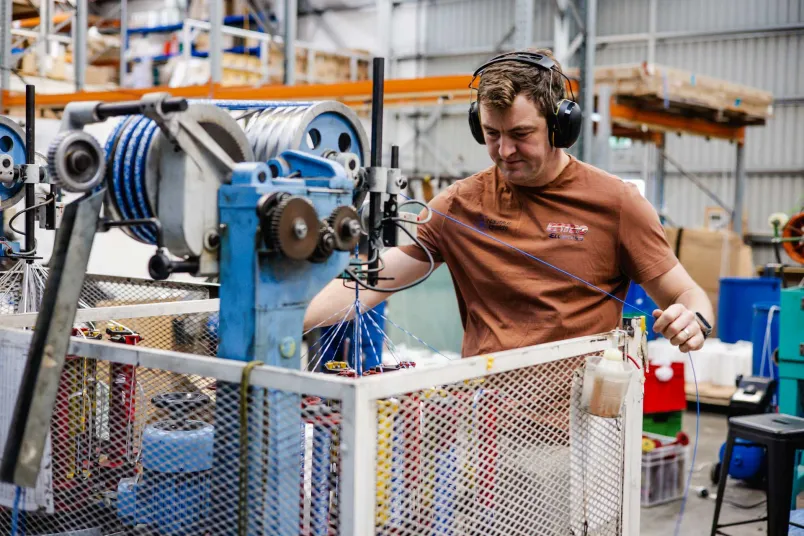
A 24-carrier braiding machine makes most of Nautilus' rope. Photos / Suellen Hurling, Live Sail Die
Nautilus began supporting sailing events by putting together prize packs containing tapered spinnaker sheets, jib sheets, mainsheets and control lines.
“I don’t think there’s an Elliott 5.9 that hasn’t won one of our prize packs yet,” McFarlane says.
The support has since extended across the sailing community, from established campaigns to young sailors finding their feet.
McFarlane mentions Sharon Ferris-Choat’s Vixen Racing campaign, and a raft of young 29er and Waszp sailors.
The company has also spoken with Naval Point Yacht Club - his home club since he moved back to Christchurch four years ago - about supplying all the lines needed for its 420 fleet free of charge.
“We're just doing what we can to help the sport we love,” McFarlane says.
"The one thing I truly love about racing is that it doesn’t matter how your day has gone. It could have been the worst day in the world — you get on the boat, by the time the five-minute gun goes, everything else just clears from your mind.
“Then it’s just about focusing on making this boat go faster, getting in front of the guy beside you. It can take your mind off all the world’s woes. It’s extremely therapeutic.”
Then there’s what happens after the racing.
"Just the passion to get out and get amongst it and do it, and tell the stories in the bar afterwards,” he explains. "We’ve all done some pretty incredible stuff, but there are many, many stories and experiences the yachting community are keen to share.”
It’s a fitting description of the community McFarlane has found himself woven into — one where sailors can be fiercely competitive on the water, then share knowledge, stories and a beer afterwards.
And perhaps that’s why the story of Nautilus Braids feels so intrinsically connected to the story of New Zealand sailing.
It started with one family, an old Davidson 28 and a problem to solve.
Decades later, the McFarlanes are still making the ropes that connect sailors to their boats — and to each other.
Related news
It’s been an action-packed month for our NZCT regional development managers around the country, with Yachting New Zealand’s ongoing membership model and affiliation fee structure review roadshow keeping the team busy.
New legislation requiring everyone on recreational craft of six metres or less to wear a properly fitted lifejacket while underway will be in place ahead of the peak summer boating season.
New Zealand kitefoiler Hugo Wigglesworth has successfully defended his Hydrofoil Big Air world title, producing a clutch performance in brutal North Sea conditions to go back-to-back at the GKA Kite World Tour’s World Championship event in Sylt, Germany.