2026 Solo Trans-Tasman Challenge: New Zealand veteran Sharon Ferris-Choat makes history as early leaders set pace in gruelling crossing

Kiwi offshore veteran Sharon Ferris-Choat has made history as the first woman since 2014 to complete the Solo Trans-Tasman Challenge and the first monohull skipper home in the 2026 edition of the iconic race.
Ferris-Choat crossed the finish line at Southport aboard her Verdier 40 Vixen Racing at 12.15pm (NZ time) on Saturday, completing the 1,400-plus nautical mile crossing in seven days, 9 minutes and 4 seconds. Her performance earned her second place overall on line honours behind Australia’s Guy Chester on the trimaran Ocean’s Tribute, and made her the first woman to finish the race in more than a decade.
She was the only female competitor to start this year’s event and just the seventh woman to contest the race in its 56-year history.
Her achievement came after a bruising Tasman crossing that delivered 40-knot squalls, thunderstorms, hail, and freezing conditions. Despite arriving with one of the strongest offshore résumés in the fleet, Ferris-Choat approached the challenge with characteristic pragmatism.
"The goal is to get there safely and competitively. The result will be what it will be," she said before the start.
Forecasts ahead of departure were daunting, with two major low-pressure systems sitting across the fleet's route from Ōpua in the Bay of Islands to Southport, Australia.
"They're boat-breaking, they're human-breaking, and they could end your race very, very quickly," Ferris-Choat said.
Those concerns proved well-founded. During the crossing, she battled sustained squalls, thunderstorms and hail, along with equipment issues including a wrapped headsail in heavy weather.
In one of her final video updates from sea, recorded with just 21 nautical miles remaining, Ferris-Choat described the toll of the final night.
"Under here I've got an emergency blanket wrapped around me just to try and give me some insulation from the dampness, and everything's icicles; it's just crazy," she said aboard Vixen Racing.
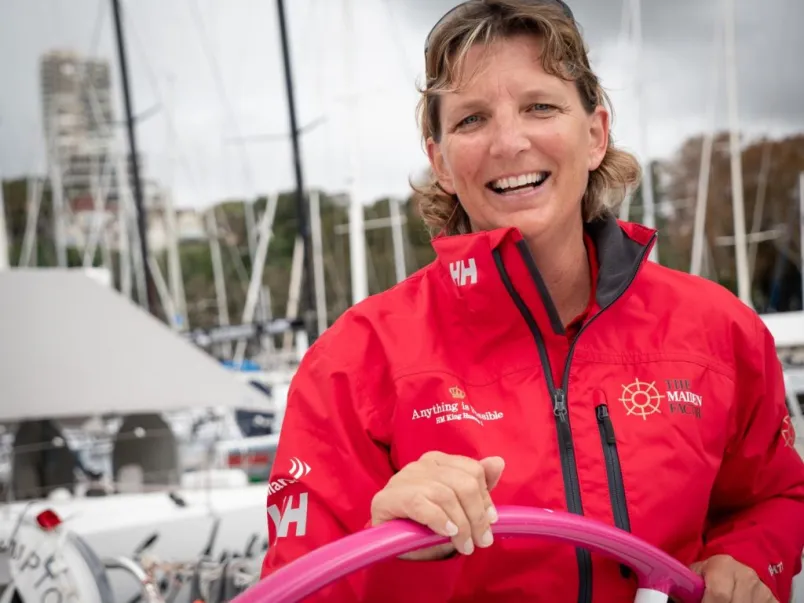
Vixen Racing skipper Sharon Ferris-Choat. Photo / Supplied
Yet even before reaching shore, she was already reflecting on what she would do differently next time.
Her finish capped a remarkable campaign built on more than 124,000 offshore racing miles, two Olympic campaigns, a Jules Verne Challenge attempt, and victory in the 2005 ORYX Quest round-the-world race.
While Ferris-Choat's achievement provided one of the defining stories of the race, overall line honours belonged to Chester aboard the Crowther Design 93 Ocean’s Tribute.
Chester crossed the finish line at Southport on Friday evening after six days, 7 hours, 34 minutes and 36 seconds at sea, becoming the first competitor home.
Speaking shortly before finishing, he described the voyage in stark terms.
"This has been the most arduous ocean crossing or passage I've done in any boat. Crewed and uncrewed," he told Boating New Zealand.
"Violent squalls, violent storms, terrible sea states, challenging weather decisions. It's a fantastic achievement to have refitted the boat, got it ready to do this race, sailed it well, and got there first. Everybody says I've got a fast multihull, but they tip over, and they can break. I’ve had to really look after her."
Chester described the victory as a crowning moment in a lifetime of sailing.
“I’ve never had a situation in 45,000 miles around the world where I couldn’t cook. I’m talking about cutting up onions and garlic and putting them in a frying pan. I couldn’t even boil the kettle,” he said.
“Been sailing for 60-odd years. This is it.”
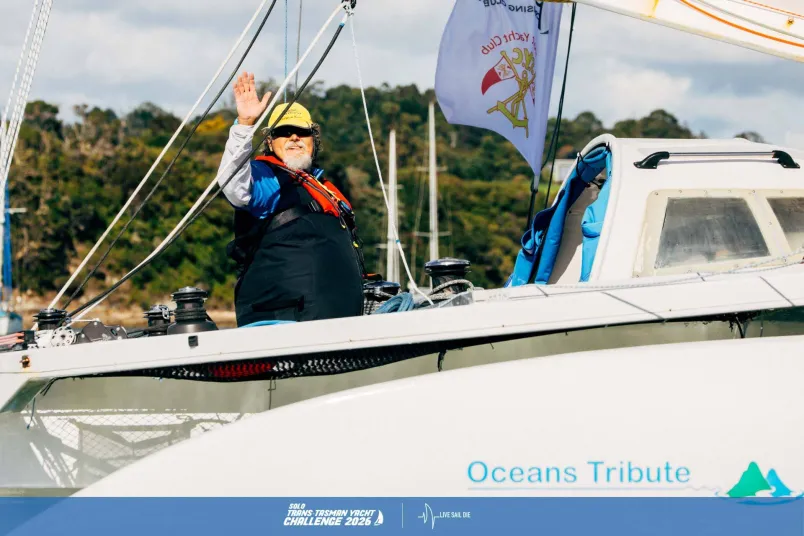
Guy Chester (Ocean's Tribute) took out overall line honours. Photo / Suellen Hurling, Live Sail Die
Meanwhile, James Foster was third boat home aboard the Mumby 48 catamaran Electron, finishing in seven days, 10 hours, 43 minutes and 58 seconds.
His performance secured first place on the New Zealand Multihull corrected time, winning the category by 3 hours, 9 minutes and 39 seconds.
Winner of the 2023 edition, Malcolm Dickson followed aboard his self-designed and self-built Dickson 55 Sarau, on Sunday morning after seven days, 18 hours, 38 minutes and 44 seconds.
The 79-year-old completed his fourth Solo Trans-Tasman Challenge and, despite finishing fourth on line honours, currently sits atop the provisional PHRF corrected-time standings.
Speaking after docking in Southport, Dickson was typically understated.
"It was about what you’d expect in the Tasman, apart from 50-knot squalls around Lord Howe that came without warning,” he said.
Just 31 minutes later, Peter Elkington brought his Young 11 Pacman across the finish line, capping one of the race’s closest battles after the two boats spent much of the crossing within sight of each other on the tracker.
By Sunday afternoon, five boats had completed the race, while four competitors — Graeme Francis (Robbery), Bill Kidman (Pretty Boy Floyd), Glen Jeffery (Wave), and Kevin Le Poideven (Roaring Forty) — had retired.
On provisional PHRF corrected time, Sarau currently leads from Pacman and Vixen Racing, although with six boats still racing across the Tasman, the final handicap placings remain far from settled.
Ben Ball’s Camellia leads the remaining fleet and is expected to be the next yacht to reach Southport, ahead of Geoff Thorn’s Catnip and Terry Dunn’s Nautilass.
Click here for the latest provisional results and standings.
Related news
- When Phoebe Willis began a textiles project at school in April, she had no idea it would take her from the boat ramp to the fashion ramp — or that a dress made almost entirely from sailing materials would turn so many heads.The young 420 sailor from Murrays Bay Saili
New Zealand windsurfing has added another name to its growing list of talent to watch on the world stage, with Honor Fyfe earning selection for the Dakar 2026 Youth Olympic Games.