Jules Verne Trophy: New Zealand sailor Rebecca Gmuer-Hornell part of first all-female crew to complete non-stop global circumnavigation

Kiwi sailor Rebecca Gmuer-Hornell has helped rewrite ocean-racing history, becoming part of the first all-female crew to complete a non-stop circumnavigation of the globe.
Gmuer-Hornell was one of eight sailors aboard the 31.5-metre maxi trimaran IDEC SPORT, sailing for The Famous Project CIC, which crossed the Jules Verne Trophy finish line off Ushant after 57 days, 21 hours and 20 minutes at sea.
The time was more than 16 days faster than the 74-day mark set by Sir Peter Blake in 1994.
While the outright Jules Verne Trophy record of 40 days and 23 hours remains untouched, the achievement signals a landmark moment for women’s sailing. The Jules Verne Trophy, named after the author of Around the World in 80 Days, is awarded for the fastest non-stop circumnavigation of the globe, with the course starting and finishing between Cornwall in England and Brittany in France, rounding the Capes of Good Hope, Leeuwin and Horn.
British sailor Tracy Edwards and her 10-strong female crew were the first to attempt the feat 27 years ago, but were forced to abandon their campaign off the New Zealand coast. In contrast, French skipper Alexia Barrier and her crew - Gmuer-Hornell, Dee Caffari, Annemieke Bes, Deborah Blair, Molly LaPointe, Tamara Echegoyen and Stacey Jackson - completed the full lap of the planet despite damage, equipment failures and severe winter storms.
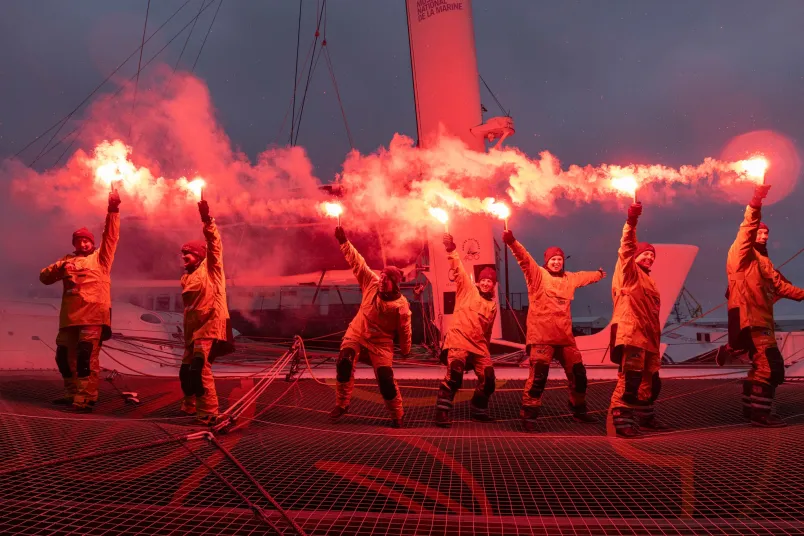
Gmuer-Hornell told RNZ the campaign was both mentally and physically demanding.
“But it's something I've wanted to do since I was a little girl, to finally get it done for myself and for the sport. I don't think I actually realised the magnitude of what we were doing until we came back. The amount of support we've had and congratulations from everyone has been insane, and we are super grateful for it,” she said.
“I think it shows that women around the world have been following it and looking up to us. And I hope it inspires young girls to think they can do it, because we were finally able to put this record in the books for women."
The multinational Famous Project crew - representing France, the Netherlands, Great Britain, Australia, the United States, Spain and New Zealand - crossed the start line near Ushant on 28 November. From the outset, they committed to a conservative strategy focused on reliability rather than outright speed.
Early Atlantic storms tested that approach, but the trimaran emerged intact and soon settled into a steady rhythm. In the tropics, favourable south-easterly trade winds allowed the crew to build confidence, clocking days of more than 500 nautical miles en route to the Cape of Good Hope, which they passed on day 17 after covering nearly 8,000 miles at an average speed exceeding 19 knots.
A jammed mainsail hook became a persistent problem, forcing repeated, physically demanding sail drops and repairs, while the Indian Ocean brought both progress and setbacks. Near Cape Leeuwin on Christmas Day, the crew logged almost 700 miles in 24 hours before snagging a fishing net on the starboard foil, rendering it unusable for the remainder of the voyage.
The Pacific leg proved decisive. After passing Point Nemo - the most remote location on Earth - the crew rounded Cape Horn on 6 January, becoming the first all-female team to do so in a non-stop multihull race. Violent seas, freezing temperatures and waves topping eight metres pushed the sailors to their limits.
“We call it the Everest of sailing. Someone came out with a statistic that only 25 women have rounded Cape Horn, and that fewer people have gone around the cape than have gone up Mount Everest. So it was a pretty big milestone for me,” Gmuer-Hornell told RNZ.
The final Atlantic leg delivered further punishment, including a torn - and later exploding - mainsail and multiple autopilot failures. Forced to hand-steer through winter storms, the crew pressed on to the finish.
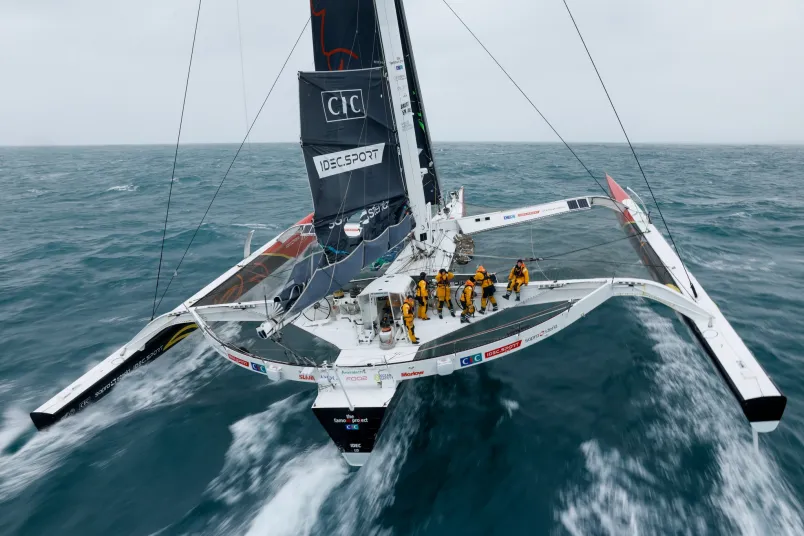
Gmuer-Hornell said she was surprised an all-female non-stop circumnavigation had not been completed sooner.
“But it's just because there hasn't been the opportunity for women to sail these boats that do high-speed records. It's definitely a male-dominated thing. So it's really cool to have been given the opportunity to sail a maxi trimaran for starters, let alone take it around the world,” she said.
She was still coming to terms with eclipsing Blake’s long-standing New Zealand benchmark.
“Sailing has come a long way since then, and innovation has been huge since Peter Blake went around the world, but being up in the leagues with him is something I never, ever dreamed of. I think I'm slowly getting my head around it, but it's been such a whirlwind over the last couple of days, it's going to take a little while to sink in,” she told RNZ.
Aged just 26, Gmuer-Hornell hails from the Bay of Islands and grew up sailing keelboats with her father, Chris. Her offshore résumé already includes a two-handed circumnavigation of New Zealand’s North Island on a TP52, multiple Caribbean 600 races, several Sydney to Hobarts, a Fastnet campaign, and extensive Royal Ocean Racing Club experience.
After relocating to the UK, she finished second at the 2025 Admiral’s Cup representing the Royal Hong Kong Yacht Club and raced in The Ocean Race Europe aboard Team Amaala. Trained as a yacht rigger, she served as IDEC SPORT’s rigger and port pitman.
Ahead of departure, Gmuer-Hornell expected the Southern Ocean to be the most intimidating section of the course.
“But it's such a quick boat that we were able to outrun all the low-pressure systems. You can position yourself in the Southern Ocean in places that are better for the wind and waves, but coming back up the Atlantic, now it's winter, there's a lot of low pressures coming into Europe from the west, and that's a lot harder to navigate,” she told RNZ.
“You have to go through them, you have to be in those eight-metre swells, liquid Himalayas we call them, and you have to be in that 50 knots of breeze. That was probably the most challenging part, the last 1000 miles."
Despite having been back on shore for only a matter of days, Gmuer-Hornell said plans were already underway for another attempt at the Jules Verne Trophy.
“Hopefully, we'll be able to push the boat a bit harder than we were this time. We had a lot of technical difficulties, we know where we lost time, and we think we can beat our current record."
Related news
It’s been an action-packed month for our NZCT regional development managers around the country, with Yachting New Zealand’s ongoing membership model and affiliation fee structure review roadshow keeping the team busy.
New legislation requiring everyone on recreational craft of six metres or less to wear a properly fitted lifejacket while underway will be in place ahead of the peak summer boating season.
In the first episode of Yarns with Yachties, a new collaborative series from Yachting New Zealand and Live Sail Die, we caught up with Andrew McFarlane at the Nautilus Braids factory in Rolleston, just outside Christchurch.