Breaking Boundaries: Women leading change in high-performance sailing

One minute, Anna Weiss was weighing up the familiar uncertainties that come with another Olympic campaign, unsure what the future might hold once the next cycle came to an end. The next, she found herself embedded in one of the most exhilarating sailing competitions on the planet, performing a role traditionally occupied by men - and doing it on a global stage.
That sharp turn, Weiss says, highlights both the unpredictability of elite sport and the importance of recognising opportunity when it presents and having the courage to seize it.
Weiss was one of three panellists at the Sail GP Breaking Boundaries forum, hosted by Yachting New Zealand at the Royal New Zealand Yacht Squadron on Saturday, ahead of this weekend's ITM New Zealand SailGP Auckland event. More than 60 women and girls attended the forum, a flagship initiative under Yachting New Zealand's Women and Girls in Sailing programme, which aims to strengthen pathways, visibility and retention for females in the sport.
Joining Weiss on the panel were Black Foils strategist Liv Mackay and SailGP's lead global physiotherapist Charlotte Porter. Chaired by broadcaster Kerre Woodham, the discussion spanned a wide range of topics - from the panellists' often non-linear journeys into high-performance sailing, to managing pressure and expectation, navigating self-belief, and balancing ambition with life beyond the boat.
For Weiss, sailing has long shaped her life decisions. After beginning her Olympic campaign in the ILCA 6, she later switched to the Nacra 17 in pursuit of her Games ambitions.
"Sailing was kind of the reason I went to university," she said. "I knew Olympic sailing was what I wanted, but I was also aware that there weren't many obvious options after the Games."

Over 60 women and girls attended the SailGP Breaking Boundaries forum, hosted by Yachting New Zealand. Photo / Hayley Gillespie
Following the Tokyo 2020 Olympics, where she represented the United States in the mixed multihull event, Weiss returned to university to complete a degree that had been paused by her Olympic campaign and the Covid-19 enforced postponement of the Games.
"I decided to switch to iQFOiL," she said. "I wasn't necessarily trying to qualify for Paris, but then I got the call about SailGP. It was a once-in-a-lifetime opportunity, and I couldn't pass it up."
That call saw Weiss step into the physically demanding grinder role with the USA SailGP team - a position she admits was initially daunting.
"I was overwhelmed at first, but like anything new, you learn," she said. "Having an open mindset and being willing to work really hard leads to more opportunities. That's how doors open."
For Porter, physiotherapy wasn't an obvious choice. A competitive sailor in her own right, she said she enjoyed both science and sport at school but wasn’t convinced a career as a physiotherapist was right for her.
"I probably applied to 10 different courses around the country and, after some big chats with my parents, decided that physio was probably best suited to me," she said.
"I didn't know it at the time, but it turned out to be the best possible career choice, as it incorporates all the things I enjoy and the people I enjoy working with."
Through her role with SailGP, Porter brings together her career and passion for the water, while championing You Row Girl, an initiative supporting an all-women's team preparing to row across the Atlantic in the World's Toughest Row.
Mackay's own journey echoed many of the same themes. A highly talented youth sailor, she enrolled in university to study accounting while balancing elite sailing commitments and a full student life. After missing Olympic selection, she threw herself into foiling and gradually worked her way into the then-fledgling SailGP circuit.
"Relationships matter," Mackay said. "Being as prepared as you can be and showing up for yourself when the chance arrives - that’s a big skill."
Now a mainstay of the Black Foils team, Mackay encouraged young sailors to develop skills beyond the racecourse, saying it provided structure, discipline and perspective.
"It's definitely good to do something alongside sailing," she said. "Other skills matter. They make you more resilient and more adaptable."
She also spoke candidly about her own struggles with imposter syndrome, advice that resonated strongly with the audience.
"We make so many mistakes every day, and we're often hardest on ourselves," Mackay said. "Getting through that and moving on is tough, but it's essential. Pathways aren't structured or linear - they rarely are."
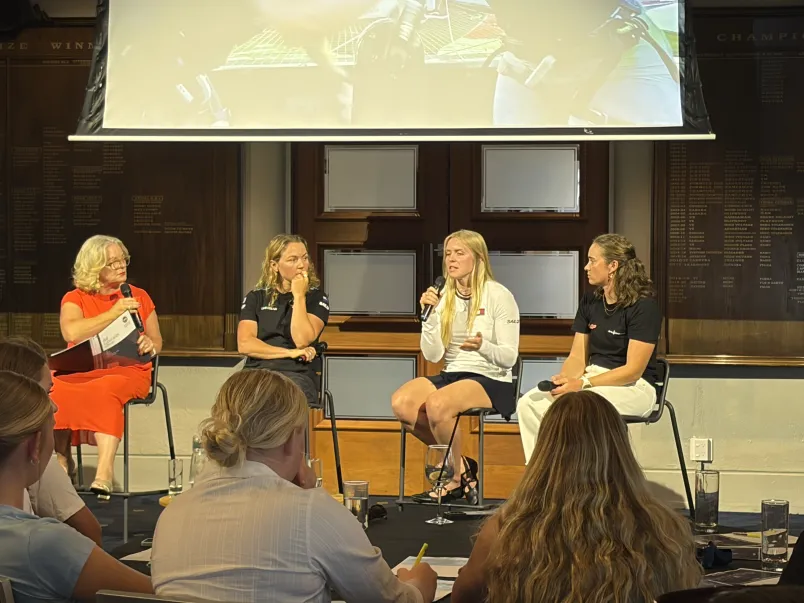
Liv Mackay, Anna Weiss and Charlotte Porter spoke candidly about their experiences. Photo / Hayley Gillespie
During breakout sessions, Mackay found herself speaking with younger girls about identifying and understanding pathways into the sport.
"They don't always see how the pieces connect," she said. "Being able to talk honestly about how you figure it out as you go was really powerful."
While significant progress has been made in levelling the playing field for women in sailing, both Mackay and Weiss acknowledged there is still work to do.
"There have been game-changing women in our sport, but momentum hasn't always been sustained. Foiling has changed things enormously and, in many ways, levelled the playing field," she said. "SailGP is fast, exciting and entertaining - and that’s helped shift perceptions."
Weiss pointed to visible change within SailGP itself.
"We're seeing more women in SailGP, and now we have Martine Grael driving," she said. "Hopefully, next season there'll be another female driver. It's a really exciting time to be putting hours in on the water, because more opportunities are coming."
She acknowledged the sport remains male-dominated, but said the pace of change has been striking.
"When SailGP started, women were brought in but often weren't sailing," she said. "To see how the roles have developed - and how quickly - is exciting. Foiling classes are growing, and they lead naturally into SailGP."
It's not only on the water where opportunities arise.
Porter, who is also a three-time silver medallist at the Match Racing World Championship, said it makes every aspect of life at SailGP more enjoyable.
"You know if you go to catering, you're going to see women there. The same goes for social events and talks - it's a really nice community to be a part of.
"Often in big organisations like these, you might think the management roles aren't held by women, but that's not the case.
"From the start, everyone at SailGP was so welcoming, and I've made so many good friends through it. Around 48.5 per cent of the SailGP workforce are women."
For Weiss, the importance of role models remains central.
"Seeing someone like Liv when I was a little girl would have meant the world to me," she said. "Hopefully, the girls here today take something away - that we were all just little girls once, who loved sailing and wanted to see how far it could take us."
Yachting New Zealand chief executive Steve Armitage said forums like Breaking Boundaries were critical as the organisation worked to both attract women and girls to the sport and ensure they remained engaged.
"Creating spaces where people can share their stories openly is really important," Armitage said. "It helps demystify the pathways into the sport and shows there isn't only one way to success.
"The sport is changing, and so are the opportunities within it. We hope everyone who came through the door today leaves with a clearer sense of where they might fit, and with the confidence to put their hand up when those opportunities present themselves."
Related news
Sailability trusts from across New Zealand met in Wellington for the inaugural Sailability National Hui to share ideas, celebrate what’s working, and explore new opportunities to grow inclusive sailing.
Kia ora koutou,
Last week we wrapped up our Club Roadshow programme. It was great to connect with so many of you around the country to discuss the future of sailing and boating.
From today, everyone on board a recreational craft six metres or less must wear a properly fitted lifejacket while the craft is underway.
This is a significant change that will improve safety on recreational craft.